
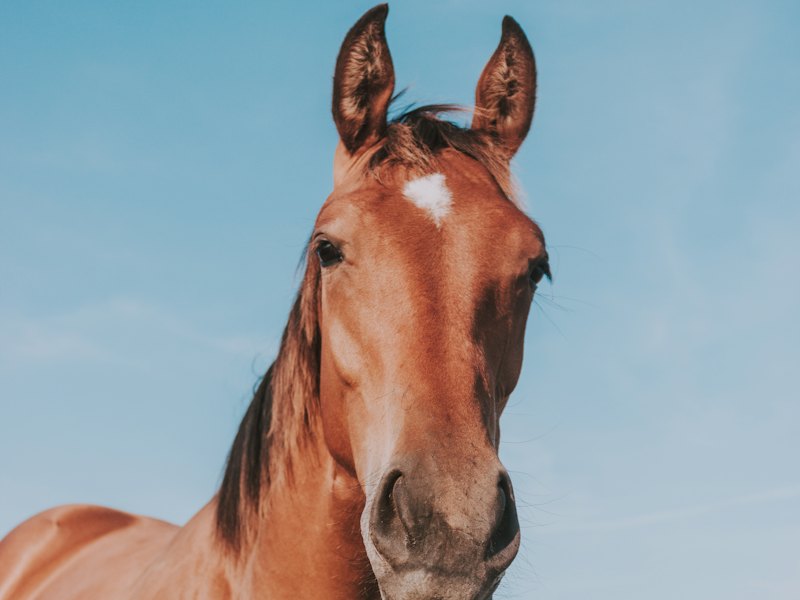
- Horses communicate through body language, facial expressions, touch, vocalisation and smell.
- Read the whole horse in context: ears, eyes, muzzle, head height, tail and legs together, and what is happening around it.
- Signs of stress or pain are often subtle, and stoic horses may show none at all.
- A sudden or repeated change in behaviour is a reason to check for pain. Horses are never simply being naughty.
How horses communicate
Horses communicate with each other through body language, facial expressions, physical touch, vocalisation and smell. Learning to read those signals tells you how a horse is feeling and how it is likely to react to you or a situation. That makes handling safer and helps you spot problems early.
A few principles help:
- Read the whole horse. Look at the ears, eyes, muzzle, head and neck, tail and legs together, not one signal on its own.
- Read the context. The same behaviour can mean different things. The British Horse Society gives yawning as an example: a sleepy horse yawning in the sun is perfectly normal, but a horse yawning repeatedly when it has been left alone may be stressed. Similarly, licking and chewing while its dinner is being made probably means a horse is keen to eat, but licking and chewing when a friend has been turned out without it may be a way of coping with stress.
- Know your horse's normal. Changes from a horse's usual behaviour are often the most useful sign of all.
Four moods to recognise
The British Horse Society teaches riders to recognise these states, and the behaviour hub shows each one on a drawing of a horse's head.
Relaxed or asleep
- Resting one hind leg
- Head and neck lowered
- Ears relaxed
- Eyes may be closed, and the lower lip may droop
- It may be lying down
Alert or excited
- Ears pricked forward, or turned towards a noise
- Head and neck raised
- Standing square, not resting a leg
- Tail carried
Annoyed or threatened
- Ears back, or pinned flat back
- Head and neck stretched out towards you, or swinging from side to side
- Nostrils wrinkled, a "pulled face", or lips drawn back to show the teeth
- The whites of the eyes may show
- Tail swishing, a foot stamped, kicking out or moving away
A horse that is protective of its stable may show some of these signs when you approach the door. A sensitive horse may show them when you groom it.
Uncomfortable or stressed
Signs of stress and pain are often subtle, and the British Horse Society warns that horses, as stoic prey animals, may outwardly show no signs at all. Signs to look out for include:
- a change in personality, such as becoming grumpy, or an uncharacteristic aggressive streak
- tension in the face, especially around the muzzle
- a dull, withdrawn expression, with a low head and half-closed eyes
- repeated yawning, or licking and chewing, in a stressful situation
- a high pulse and breathing rate with no obvious explanation, which is a reason to call the vet
- loose droppings, or more droppings than usual
- apathy: losing interest in what is going on
- stereotypic behaviour such as box walking, weaving or crib biting (see Stress and stereotypic behaviour)
Bransby Horses describes the posture of a horse that has shut down: standing for long periods with head and neck low, a glazed look, sometimes facing a wall, and losing interest in food. The horse may seem withdrawn but still spook at things that wouldn't normally worry it. Bransby advises having any signs of stress or depression checked by a vet.
Spot the difference: resting or uncomfortable?
Some signs look alike but mean different things. Resting a hind leg is part of a relaxed horse's posture. But the British Horse Society lists continuously resting the same leg, or shifting weight between legs, as a possible sign of discomfort. A horse lying down is often simply resting, but lying down more than usual, repeatedly shifting to get comfortable and struggling to stand can point to pain.
Signs of pain and discomfort
The British Horse Society publishes a table of behaviours that can indicate discomfort or lameness. In the stable or field, they include:
- moving around less than usual
- disliking having the feet picked up
- lying down more, or struggling to get up
- leaning against a wall, fence or hedge to rest
- resentment when tacked up: ears back, trying to bite or kick, grinding the teeth, tossing the head
Under saddle, they include:
| Ridden sign | What to look for |
|---|---|
| Ears | Repeatedly back or flat, one or both, for five seconds or more |
| Eyes | An intense, glazed, "zoned-out" stare for five seconds or more |
| Mouth | Opening and shutting repeatedly, with the teeth apart, for ten seconds or more |
| Head | Regularly tossing or twisting from side to side |
| Tail | Swishing repeatedly, especially in transitions; or clamped tightly, or held to one side |
| Movement | Reluctance to go forward, stopping on its own, bucking or rearing |
| Mounting | Fidgeting, tail swishing, head tossing, or walking off as soon as the rider is on |
| Performance | Lower dressage marks, more poles knocked down |
Dr Sue Dyson's research, which World Horse Welfare highlights, compared lame and sound horses. It found 24 behaviours that are much more common in horses in pain, including some few people would link to pain, such as spooking, swishing the tail and tilting the head. She also found that lameness, back pain and poorly fitting saddles were associated with unwanted behaviour during tacking up and mounting.
If your horse shows signs of pain or discomfort, or a sudden change in behaviour, contact your vet. Rule out pain before treating a behaviour as a training problem. If your vet finds no physical cause, a qualified equine behaviour professional can help.
This guide cannot diagnose your horse. If in doubt, call.
Sources
- About the Horse Introduction award: coach guidance — The British Horse Society (accessed 8 October 2026)
- Horse Knowledge Part Two checklist guidance — The British Horse Society (accessed 8 October 2026)
- Equine stress — The British Horse Society (accessed 8 October 2026)
- Lameness: signs, assessment and diagnosis — The British Horse Society (accessed 8 October 2026)
- Behaviour checklist: is your horse trying to tell you something? — World Horse Welfare (accessed 8 October 2026)
- Tacking up and ridden behaviours — World Horse Welfare (accessed 8 October 2026)
- Equine behaviour — Bransby Horses (accessed 8 October 2026)