
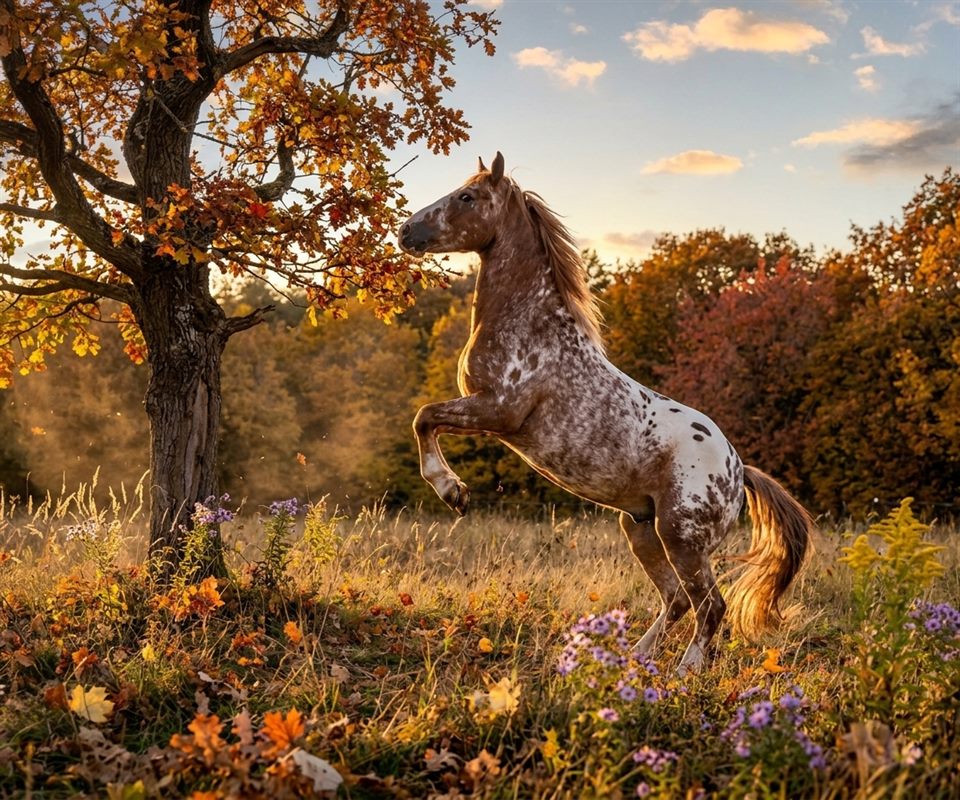
- Most cases of atypical myopathy happen in autumn. Clear sycamore seeds and leaves, and limit grazing near sycamores to under six hours a day.
- Keep horses away from fallen acorns until they're cleared.
- Grass can be high in sugar on frosty autumn days, so watch horses prone to laminitis.
- Move a horse from summer turnout to stabling over 10–14 days.
- Find out when fireworks are planned near you, and prepare your horse weeks ahead.
Autumn is the season for getting ready: for wet fields, shorter days and, for many horses, more time indoors. It also brings two of the year's main poisoning risks, as sycamore seeds and acorns fall.
Sycamore seeds and atypical myopathy
The BHS says most cases of atypical myopathy happen in autumn, when sycamore seeds and leaves fall onto the grass and are eaten. The toxin, hypoglycin A, stops the muscles producing energy. Horses can get worse within 6–12 hours, and the BHS puts the death rate at around 56–61%. It isn't known why some horses are affected and others aren't, and it can hit one horse or several in a group.
The BHS's advice:
- Clear seeds and leaves from the field regularly. A field with no sycamores can still be at risk, because the seeds blow in.
- Limit grazing to less than six hours a day where sycamores are near the field.
- Give extra forage on poor grazing, so horses don't go looking for seeds. In 64% of cases reported to the Atypical Myopathy Alert Group between 2006 and 2019, there was very little grass. Feed hay away from sycamores, ideally in feeders.
- Don't harrow, which may spread sycamore material across the field.
- Avoid natural water such as streams in high-risk seasons, as the toxin dissolves in water. Give another water supply.
Signs include stiff or trembling muscles, sweating, a high heart rate, dullness with the head held low, dark red or brown urine, weakness or difficulty standing, and difficulty breathing. Call your vet urgently if you're worried.
Acorns
Oak acorns, leaves and branches can poison horses. Acorn poisoning is rare because acorns taste bitter, but the BHS says some horses seek them out even with good grazing, and more cases are seen in years with a big crop. More acorns fall after strong winds, and horses on short, overgrazed grass are more likely to eat them.
- Keep horses out of a field with acorns until they're cleared, by paddock vacuum or sweeper, or by raking them up.
- If you can't clear them straight away, give good forage away from the oaks, or fence round the tree, ideally out to the edge of its branches.
- Check the field carefully before turning horses out. The BHS says it should be safe again in spring, once the acorns are cleared and the tree has stopped dropping them.
Signs include acorn husks in the droppings, dullness, lying down more, eating less, colic, constipation or bloody diarrhoea, and mouth ulcers. Call your vet if you suspect it.
Frosty grass
Bransby Horses warns that grass is higher in sugar not only in spring and summer but also on frosty autumn days, so keep watching horses prone to laminitis. Its advice is to use the winter months to bring an overweight horse's weight down naturally, ready for the spring grass. See weight and fat scoring.
Coming in for winter
If your horse will spend more time stabled over winter, make the change gradually over 10–14 days, says the BHS, to reduce the risk of colic. World Horse Welfare suggests adding as little as 10 extra minutes a day at first, and smaller steps for horses that find it stressful. Less movement and the switch from grass to hay both raise the risk of colic. Life in the stable has more, including social stabling and enrichment.
Worms and tapeworm
The BHS suggests faecal worm egg counts three or four times a year between spring and autumn, and a tapeworm test twice a year, ideally in spring and autumn. Your prescriber will advise on encysted small redworm over the winter, when egg counts aren't much use. Keep picking up droppings at least twice a week.
Getting fields ready for the wet
The BHS's autumn jobs:
- Check there's hardstanding around gates and water troughs before winter.
- Keep ditches clear of plants and debris so they keep draining.
- Check the pipes to troughs are insulated.
Ragwort seedlings appear in autumn, says World Horse Welfare: pull them while they're small. Field shelters and living out has more on mud and shelter.
Fireworks
World Horse Welfare's advice for fireworks season, and for displays at New Year or weddings:
- Find out where and when local displays are, and ask neighbours to tell you if they're planning one.
- Keep the routine. A sudden change on the night can itself be stressful. If a display is close and your horse lives out, it may be best left in its usual field. If you plan to stable it, start bringing it in about a week before, and only for a few hours around the display, not all night. Practise with the stable set up as it will be on the night.
- Be ready for fire. Keep extinguishers, sand and water near the stables, and know the yard's fire drill.
- On the night, give plenty of hay, play a radio out of reach in the stable to mask the noise, stay calm and check on your horse regularly. Don't handle a horse that's behaving dangerously.
- The morning after, check your horse for injuries, and the field and water trough for firework debris.
Shorter days
As the evenings draw in, the BHS recommends hi-vis and lights whenever you ride: at least a hi-vis jacket or tabard for you and leg bands for your horse, with LED lights where possible. It doesn't recommend going out at night or in poor visibility, and notes that some colours blend into hedges at certain times of year.
Feet and coats
Hoof abscesses are more common in spring and autumn, when the ground swings between wet and dry (see hoof problems). Rain scald is often seen in autumn and winter (see skin and coat problems). As coats grow, think about whether your horse will need clipping or a rug this winter.
Sources
- Atypical myopathy — The British Horse Society (accessed 9 October 2026)
- Acorn poisoning — The British Horse Society (accessed 9 October 2026)
- Tips for weight management — Bransby Horses (accessed 9 October 2026)
- Winter care — The British Horse Society (accessed 9 October 2026)
- Changing horses' routines — World Horse Welfare (accessed 9 October 2026)
- Risk-based worm control in horses — The British Horse Society (accessed 9 October 2026)
- Pasture management — The British Horse Society (accessed 9 October 2026)
- Ragwort: how to deal with it in a horse paddock — World Horse Welfare (accessed 9 October 2026)
- Fireworks: keeping your horse safe — World Horse Welfare (accessed 9 October 2026)
- Hi-vis — The British Horse Society (accessed 9 October 2026)
- Rain scald — The British Horse Society (accessed 9 October 2026)
- Hoof abscesses in horses — The British Horse Society (accessed 9 October 2026)